

Have you ever wondered whether to write “I would love to” or “I would love to too”? You are not alone! Many English learners struggle to choose between “to” and “too” because both words sound alike but serve different purposes. Using the wrong word can make your sentence confusing or grammatically incorrect.
The good news is that understanding their difference is easier than you might think. Whether you are writing messages, composing emails, or preparing for an English exam, knowing the correct usage can improve your writing. In this guide, you will discover the difference between “to” and “too,” learn practical examples, and find simple tips to avoid common mistakes.
To or Too: Which One Is Correct?
Both spellings look almost the same, which is why people mix them up. The short answer is that to and too are both correct words, but they do different jobs. Using the wrong one changes the meaning or just makes the sentence look off.
Think of to as a road sign. It points you toward a place, a person, or an action. Too works more like a sticky note that adds a little extra, like a friend saying, “me too.”
So which one fits your sentence? It depends on what the word is doing. Keep reading, and you’ll see exactly how to choose.
Meaning and Definition of To and Too
Before we get into rules, let’s define each word clearly. Dictionaries treat to and too as separate words with separate jobs. Knowing the meaning is the first step toward using them well.
What Does “To” Mean?
The word to works as a preposition and as a marker for infinitive verbs. It shows direction, like going to the market. It also shows an action, like wanting to sleep.
Here’s a quick example. You want to travel to Paris next spring. The first “to” belongs to the infinitive verb “to travel,” while the second “to” shows direction toward a city.
What Does “Too” Mean?
Too is an adverb with two main meanings. It can mean also, as in “I’m coming too.” It can also mean excessively, as in “The soup is too hot.”
A simple trick helps here. If you can swap in “also” and the sentence still works, you probably need too.
When Should I Use To or Too?
Choosing between them gets easier when you ask one question. Is the word showing direction or action, or is it adding something or going over a limit? That single question solves most cases.
When to Use “To” Before a Verb
Use to before a base verb to form an infinitive. Phrases like to eat, to go, to learn, and to travel all follow this pattern. Usually, the phrase answers the question, “What do you want to do?”
For example, I’d like to learn a new language this year. Here, “to learn” is the infinitive, and nothing in the sentence means “also,” so the word stays as to.
When to Use “Too” to Mean Also or Excessively
Use too when you mean also or when you mean more than enough. At the end of a sentence, it usually means also. Before an adjective, it usually means excessively.
Consider these examples: “Me too!” and “I can help too.” Compare them with “The room was too crowded for a quiet chat.”
I Would Love To or Too: Which Is Correct?
This is the question that sends most people to search, so let’s answer it directly. The correct phrase is I would love to. The version with too is a mistake.
Why? Love is followed by to plus a verb, just like “I want to” or “I hope to.” Too doesn’t fit that pattern at all.
Picture a friend texting, “I would love too come to your party.” Her meaning is clear, but the spelling jumps out right away. Swap in to, and the message reads smoothly.
Is “I Would Love Too” Correct?
No, “I would love too” is not correct. The word too adds nothing useful here, and it breaks the infinitive verb pattern.
Use I would love to instead. For example, “I would love to come” reads naturally and gets your point across.
Is “I Would Love To Too” Grammatically Correct?
Not in standard writing. The phrase “I would love to too” repeats the idea and reads awkwardly. You might see it in casual chats, but it still isn’t clean.
If you want to add also, place too at the end. For example, “I would love to join you, too.” This version is clear and correct.
She Would Love To or Too: Which One Is Right?
Use “She would love to.” The rule stays the same for any subject, whether it’s he, she, we, or they. Add too only when you mean also, such as “She would love to go, too.”
For example, she would love to visit Paris. She would love to visit Paris, too, if her sister joined the trip.
Key Differences Between To and Too
These two words look close, but their jobs are very different. Here’s a quick breakdown you can scan in seconds.
- To shows direction, a goal, or the start of an infinitive verb.
- Too means also or excessively, and it often sits at the end of a clause.
- To usually comes before a verb or a noun, as in “to school.”
- Too usually comes before an adjective, as in “too late.”
Notice the pattern? If the word leads into a place or an action, it’s to. If it adds something or shows excess, it’s too.
To vs Too: Quick Comparison Table
The table below sums up the core differences. Keep it handy when you’re not sure.
| Feature | To | Too |
| Part of speech | Preposition or infinitive marker | Adverb |
| Main job | Shows direction or action | Adds “also” or shows excess |
| Common example | I want to sleep | I want to sleep, too |
| Can you swap in “also”? | No | Usually yes |
| Typical position | Before a verb or noun | End of a clause or before an adjective |
This table shows the core split at a glance. When in doubt, test the sentence by swapping in “also.” If it still makes sense, you need too.
Examples of To and Too in Sentences
Examples make the rules click faster. Read these, then try writing a few of your own.
Examples of “To” in Sentences
We drove to the beach on Sunday. He needs to finish his report today. They plan to move to Dubai next year.
Each sentence uses to for direction or to start an action. None of them means “also,” so the spelling stays the same.
Examples of “Too” in Sentences
I’m hungry too. The coffee is too hot to drink. Your shoes are too big for me.
The first sentence uses too to mean also. The other two use it to show excess.
Examples of “I Would Love To” and “I Would Love To Too”
I would love to join you for dinner. I would love to learn a new language this year. I would love to help you move on Saturday, too.
The first two use I would love to correctly. The last one adds too at the end to mean also, which is the clean way to say it.
Is It To or Too Late?
Too late is correct when you mean it’s past the right time. Here, too means excessively, as in “too late for the bus.”
“To late” is a typo that sneaks in when you type fast. Try the test again: swap in “very” or “overly.” If it fits, you need too.
You Too or You To: Which Is Correct?
You too is correct. Use it when you return a greeting or a wish. For example, “Have a great trip!” “You too!”
You to is a mistake in almost every case. The word to doesn’t fit after “you” in that setting.
Common Mistakes When Using To and Too
Most errors come from speed and habit. Watch for these three patterns.
Using “Too” Instead of “To”
Writers often type too before a verb by accident. For example, “I want too travel” should read “I want to travel.”
Slow down before you hit send, and check the word right before the verb.
Using “To” Instead of “Too”
The reverse happens when someone means also but types to. For example, “Me to!” should be “Me too!”
Read the sentence out loud. If you hear “also,” the word needs two Os.
Confusing “I Would Love To” With “I Would Love Too”
This mistake shows up often in texts and captions. The phrase needs to, so check that final word before you send.
A quick proofread takes five seconds and saves you from looking unsure.
Easy Tips to Remember the Difference Between To and Too
You don’t need a grammar degree to get this right. A few simple tricks cover almost every case.
Remember That “Too” Has an Extra O
Think of the extra O as extra meaning. Too adds something, like “also,” or it shows an excess, like “too much.”
Replace “Too” With “Also” to Check the Meaning
Swap in also. If the sentence still works, too is correct. For example, “I’m coming too” becomes “I’m coming also,” which makes sense.
Check the Meaning of the Sentence
Ask yourself whether the word shows direction or action. If it does, pick to. If the word adds something or goes over a limit, pick too.
Grammar Rules for To and Too
Here are the core rules in one place. Keep them handy for quick checks.
Using “To” With Infinitive Verbs
Infinitive verbs use to plus the base form of the verb. Examples include to eat, to go, and to learn.
Certain verbs often take this form, such as want, hope, and love. That’s why “I’d like to” and “I’m interested in” work so well in everyday speech.
Using “To” as a Preposition
As a preposition, to shows direction or a recipient. For example, “Give the book to Sara” shows who receives the book.
Other examples include “to school” and “to the market.” These phrases point toward a place or a person.
Using “Too” as an Adverb
Too modifies adjectives, verbs, and whole clauses. For example, “The test was too hard” uses it to show excess.
It can also mean also. “I passed too” shows that you passed along with someone else, or in addition to something.
Synonyms and Related Words for To and Too
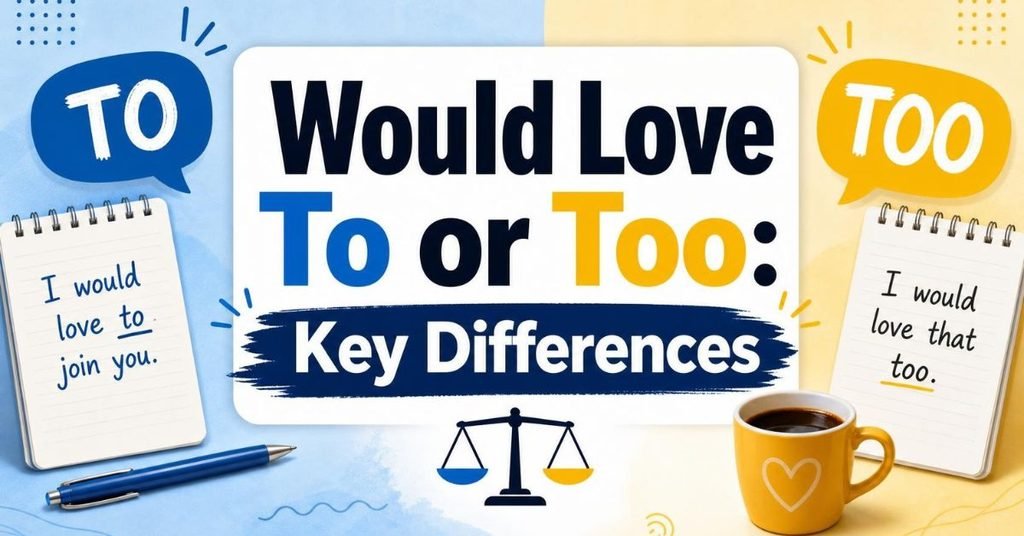
Synonyms help when you want variety, or when a sentence needs a different tone. Here’s what you can use.
- For too meaning also, try as well, in addition, or besides.
- For too meaning excessively, try very, overly, or extremely.
- For to showing direction, try toward or into.
Use “also” or “as well” when you want a softer feel. Swap in “very” or “overly” when you mean excess. Note that to in an infinitive has no real synonym, so keep it as it is.
Frequently Asked Questions About To or Too
Is I Would Love Too Correct?
No, I would love to is correct. For To or Too, too adds nothing here and breaks the infinitive pattern.
When Should I Use Too at the End of a Sentence?
Use too at the end when you mean also. This is a simple To or Too rule, like I’m coming too.
Can I Say I Would Love To Also?
Yes, but it’s clunky. Try I would love to join you, too, which follows the To or Too rule best.
What Is the Difference Between To and Too?
To shows direction or starts an action. Too means also or excessively. That split is the heart of To or Too.
Is I’d Love To or I’d Love Too Correct?
I’d love to is correct, and I’d love too is a typo. For To or Too, follow love with to plus a verb.
What Does I’d Love Too Mean?
It usually signals a typo for I’d love to. Most To or Too mix ups happen when people type fast.
Why Do People Confuse To and Too?
The words sound alike and look nearly identical. Fast typing and autocorrect add to the To or Too confusion.
Conclusion
So, back to the big question. I would love to is the correct phrase, and that answer never changes. The To or Too rule is easy once you test the sentence. Ask whether the word shows direction or action, or whether it adds something extra. That quick check solves most To or Too problems in seconds. Trust the test, and you’ll get it right every time.
Keep this guide handy the next time you hit send. Read your message out loud, and listen for how the sentence sounds. Small habits like these make To or Too mistakes disappear over time. Now it’s your turn. Drop a comment with your toughest To or Too example, and share this post with a friend who still gets stuck on To or Too. Your readers will thank you for it.


1 thought on “Would Love To or Too: Which One Is Correct?”