

Cancellation vs Cancelation trips up a lot of writers, and you are not alone if you have paused mid sentence wondering which one to use. Both words point to the same idea, stopping or calling off something planned. But only one spelling shows up in most dictionaries, news articles, and business emails.
The other pops up now and then, mostly in casual writing. This guide breaks down the meaning, the correct spelling, and where each version actually belongs. You will also get real examples, a quick comparison table, and a simple trick to remember which one to pick every time.
What Does “Cancellation” Mean?
Cancellation is the noun form of cancel. It means the act of canceling something, whether that is a flight, a meeting, or a subscription.
You will see it everywhere, from a flight cancellation notice at the airport to a cancellation policy on a hotel booking page. It is the standard spelling used in formal writing, professional writing, and everyday news reporting. If you are drafting a business email or a legal notice, this is the word you want.
Think of it this way: whenever something planned gets stopped before it happens, cancellation is the word doing the heavy lifting.
Cancellation vs Cancelation: Which Spelling Is Correct?
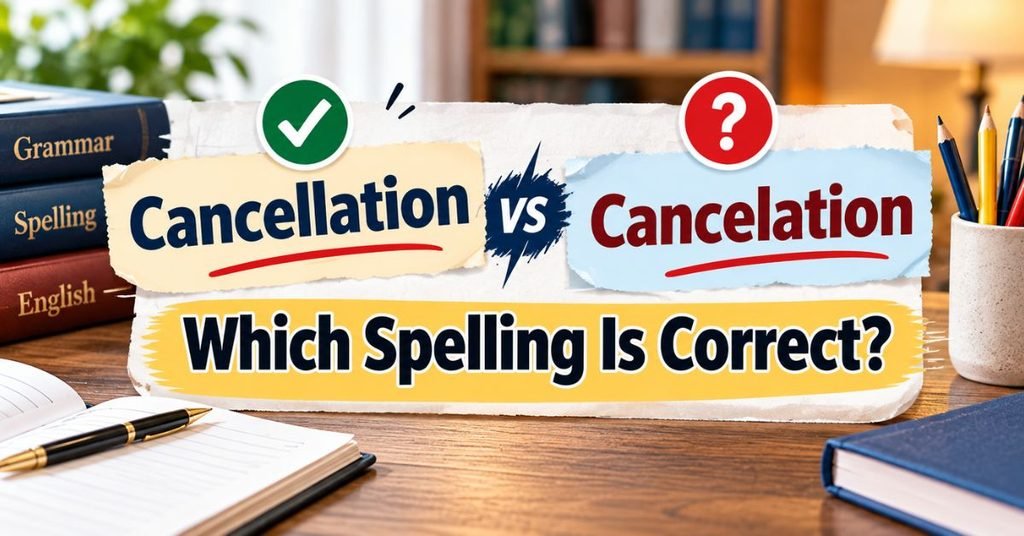
Cancellation, spelled with a double l, is the correct spelling almost everywhere. It is the standard spelling in British and American English alike, and it is the version you will find in every major dictionary.
Cancelation, with a single l, is technically a valid word too, but it is a rare spelling. Most style guides and dictionaries list it as an accepted variant, not the main entry. So while cancelation will not get flagged as flat out wrong, it will look out of place in a resume, a news article, or academic work.
When in doubt, double the l and move on with your writing.
Also Read : Sentence or Sentance: Meaning, Examples & Correct Usage 2026
What About “Cancelation”?
Cancelation is not a typo, but it is not the go to choice either. This informal American English version shows up mostly in casual writing, quick notes, or personal blogs.
It follows a different spelling logic than cancellation, dropping one l for a leaner look. Some writers pick it simply out of habit, without realizing the double l version is far more common. Others use it in informal or rare contexts where strict grammar rules matter less.
If your writing needs to look polished, cancelation is a risky pick.
Why Do “Cancellation” and “Cancelation” Have Different Spellings?
This comes down to basic spelling rules around adding suffixes. Cancel ends in a single l after a vowel, and English has never fully agreed on whether to double that l before adding ation.
Cancel → Cancel + L + ation = Cancellation is the pattern British English locked in centuries ago, and American English mostly followed suit for this particular word. A few American spellings do drop the extra letter in similar cases, like traveler versus traveller, which is why some writers assume cancelation should work the same way. It does not, at least not as the dominant form.
Pronunciation is the same for both spellings, so your ear will not help you pick the right one. Your eyes will, once you know the pattern.
Canceled or Cancelled: AP Style
Here is where things get a little tricky. AP style, the guide most American newsrooms follow, actually prefers canceled with one l, and canceling with one l too.
But cancellation keeps its double l even under AP style, because it is treated as a fixed, standard spelling rather than a suffix rule. So a news article might write canceled flight but still say flight cancellation in the very next sentence. British publications, on the other hand, typically stick with cancelled and cancelling throughout.
Knowing your style guides matters here, especially if you write for a specific publication or company.
Cancellation vs Cancelation Examples
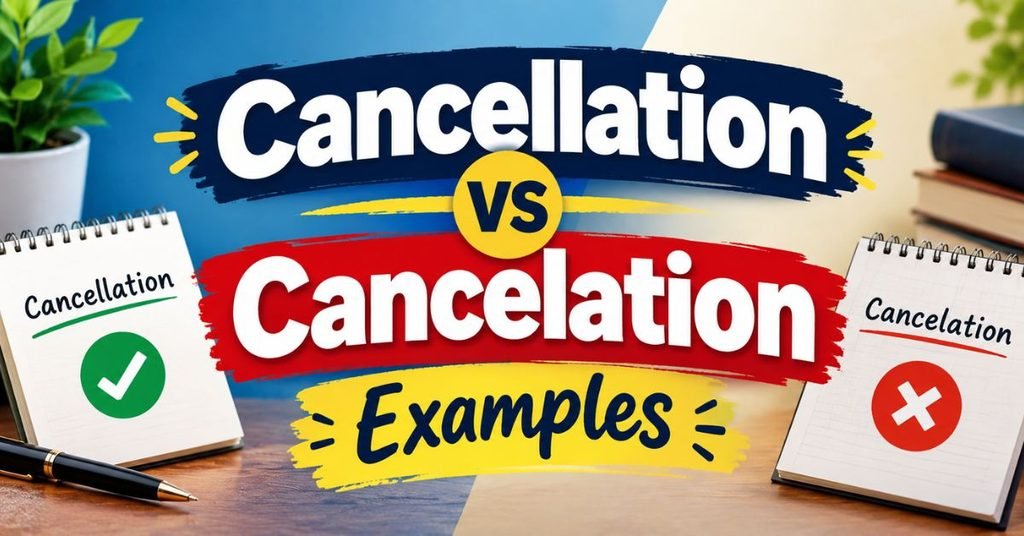
Seeing these words in context makes the difference click faster than any rule ever could.
- The airline sent a cancellation notice an hour before departure.
- Her gym membership cancellation took less than five minutes online.
- The appointment cancellation left an open slot for another patient.
- He asked about the store’s cancellation policy before buying tickets.
- The team announced the cancellation of events due to bad weather.
Cancelation would technically fit in every one of these sentences, but readers expect the double l version, and swapping it in makes writing look inconsistent.
Also Read : Tomatoes or Tomatos: Avoid This Common Spelling Mistake 2026
Comparison Table: Cancellation vs Cancelation
| Feature | Cancellation | Cancelation |
| Spelling | Double “l” | Single “l” |
| Status | Correct spelling, widely used | Accepted variant, rarely used |
| Region | British English and American English | Occasionally American English |
| Best for | Formal writing, professional emails, academic papers | Casual notes, informal writing |
| Dictionary listing | Primary entry | Secondary or variant entry |
| Pronunciation | Same | Same |
This table alone should settle most doubts, since one column clearly does more work than the other.
Common Mistakes & How to Avoid Them
Writers slip up with these words more often than you would think, and the mistakes usually follow a pattern.
- Using cancelation in a resume or cover letter, where professional writing standards expect the double l.
- Mixing spellings within the same document, which reads as careless even when the meaning is clear.
- Assuming canceled and cancellation follow the same rule, when AP style treats them differently.
- Forgetting that canceling vs cancelling also splits along British and American lines, just like the noun form.
A quick fix: pick one spelling system, British or American, and stay consistent across canceled, canceling, and cancellation throughout your document.
Real-Life Examples
A concert cancellation notice usually goes out through email and social media within hours of the decision. Airlines handle a flight cancellation with rebooking options, refunds, or travel credit, depending on the reason behind it.
A subscription cancellation often needs just a few clicks now, thanks to consumer protection rules pushing companies toward simpler processes. Restaurants and event venues deal with order cancellation and cancellation of reservation requests daily, especially around holidays.
Even scientists talk about cancellation of experiments when funding falls through or results raise safety concerns. Across every one of these situations, the double l spelling is the version doing the actual work.
British vs American English Usage
British English almost universally favors cancellation, cancelled, and cancelling, all with double l spellings. American English agrees on cancellation but splits on the shorter forms, generally preferring canceled and canceling with a single l.
This creates an odd but real pattern: Americans double the l for cancellation, yet drop it for canceled. British writers double it consistently across all three words, which honestly makes their version easier to remember.
If you write for a British audience, double the l everywhere. If you write for an American audience, double it only in cancellation.
Is “Cancelation” Ever Correct?
Yes, cancelation is technically correct, just not the expected choice. Dictionaries list it as a valid but minor variant, similar to how alright exists alongside all right.
It will not confuse a reader, since pronunciation is the same and the meaning never changes. But in formal writing, academic papers, or professional emails, it can come across as a small error even when it is not one.
Save cancelation for casual, low stakes writing, and lean on cancellation everywhere else.
How to Remember the Correct Spelling
A simple mnemonic makes this whole debate easy to settle for good. Picture the formula Cancel → Cancel + L + ation = Cancellation, and repeat it until it sticks.
Another trick: count the l’s like you are counting importance, two l’s for the more important, more common spelling. If a word feels formal enough for a contract or a news headline, it almost always gets the double l treatment.
Say the word slowly and picture it written in a dictionary entry, since that mental image tends to default to the double l version anyway.
Cancellation in Professional and Academic Writing
Editors, teachers, and hiring managers expect the standard spelling without exception. A single stray cancelation in a formal document can distract a reader from otherwise strong writing.
Academic journals follow strict style guides, and nearly all of them list cancellation as the required form. Business emails, contracts, and official notices follow the same expectation, since consistency signals professionalism.
When your writing needs to be taken seriously, cancellation is simply the safer, smarter choice.
Frequently Asked Questions
What is the correct spelling, cancellation or cancelation?
Cancellation is correct almost everywhere. Cancelation is valid too, but it stays rare and informal.
Is cancelation a real word?
Yes, cancelation is a real, dictionary listed word. It just is not the standard spelling most writers use.
Do British and American English spell cancellation differently?
No, both use cancellation with a double l. They differ instead on canceled versus cancelled.
Why does canceled have one l but cancellation has two?
AP style prefers single l for canceled and canceling. Cancellation keeps its double l as a fixed, standard spelling.
Can I use cancelation in a business email?
You can, but cancellation looks more polished and professional. Most readers expect the double l version in formal writing.
Is the pronunciation different between the two spellings?
No, pronunciation is the same for both. Only the spelling and formality level actually change.
Conclusion
Cancellation vs Cancelation really comes down to one simple choice: double l almost every time. Cancellation is the standard spelling, trusted by dictionaries, news writers, and professionals everywhere. Cancelation still exists, but it stays casual and rare, better suited for quick notes than serious writing.
Once you remember the formula, cancel plus l plus ation, this whole debate stops being confusing. Stick with cancellation for anything formal, professional, or academic, and save cancelation for relaxed, low stakes moments. Either way, you now know exactly which spelling fits which situation, and that clarity is worth more than memorizing another random grammar rule.


3 thoughts on “Cancellation vs Cancelation: Meaning & Correct Spelling 2026 ”